
Thinking about a Randy’s Donuts franchise as your first business? This guide compares the donut shop franchise path with going independent, then shows why first-time owners choose Randy’s.
Key Takeaways
- The U.S. doughnut store industry reached $9.5 billion in 2024 and continues to grow, according to IBISWorld.
- New franchised businesses survive at a 6 to 8 percentage-point higher rate than independents in their first two years, per the Michigan Ross School of Business.
- Randy’s Donuts averaged $1,026,789 in gross sales across 19 affiliate-owned and franchised shops during the 2025 Measured Period, and its 9 franchised shops averaged $825,778.
- A single Randy’s Donuts location has a total estimated initial investment of $400,500 to $499,500, and a five-store hub-and-spoke development is estimated at about $2.5 million.
According to IBISWorld, the U.S. doughnut store industry reached $9.5 billion in 2024, growing about 1.4% annually from 2019 to 2024. While independent shops face high risks, franchise donut shops provide a proven path with brand recognition, hands-on training, operational systems, and marketing support.
Among donut shop franchises, Randy’s Donuts stands out for its iconic branding and scalable hub-and-spoke model. It reported $1,026,789 average gross sales across 19 affiliate-owned and franchised shops (10 affiliate-owned and 9 franchised) during the 2025 Measured Period.
The Growth of the Donut Shop Franchise Industry
IBISWorld puts the U.S. doughnut store industry at $9.5 billion in 2024, growing about 1.4% annually from 2019 to 2024. The global coffee and bakery café industry keeps expanding as consumers look for convenient, indulgent breakfast options. Demand for donuts paired with coffee makes this a resilient business model.
This growth presents a major opportunity for entrepreneurs. By joining an established donut shop franchise, new owners can tap into a market with proven demand. They also avoid the risks of building an unknown brand from scratch.
Why Choose a Donut Shop Franchise Over Going Independent?
Starting an independent donut shop may sound appealing, but it comes with challenges:
- Building recognition from scratch can take years.
- Owners must develop their own recipes, staff training, daily processes, and vendor relationships.
- Independent shops carry the full cost of advertising and customer acquisition.
- Finding and securing a strong location falls entirely on the owner.
By contrast, franchise donut shops offer clear advantages:
- Customers already know and trust an established brand name.
- Proven operational systems reduce trial and error.
- Ongoing guidance helps maintain quality and efficiency.
- Structured models often allow multi-unit expansion.
The stakes are real for new owners. Data from the U.S. Bureau of Labor Statistics shows about 49% of new businesses close within five years.
Franchising can improve those odds early on. The Michigan Ross School of Business found new franchised businesses survive at a 6 to 8 percentage-point higher rate than independents early on. That advantage fades after year two.
Franchising also carries real economic weight. The International Franchise Association’s 2025 Economic Outlook reports that U.S. franchises generated $896.9 billion in economic output in 2024 and supported 8.8 million jobs.
Why the Randy’s Donuts Franchise Stands Out
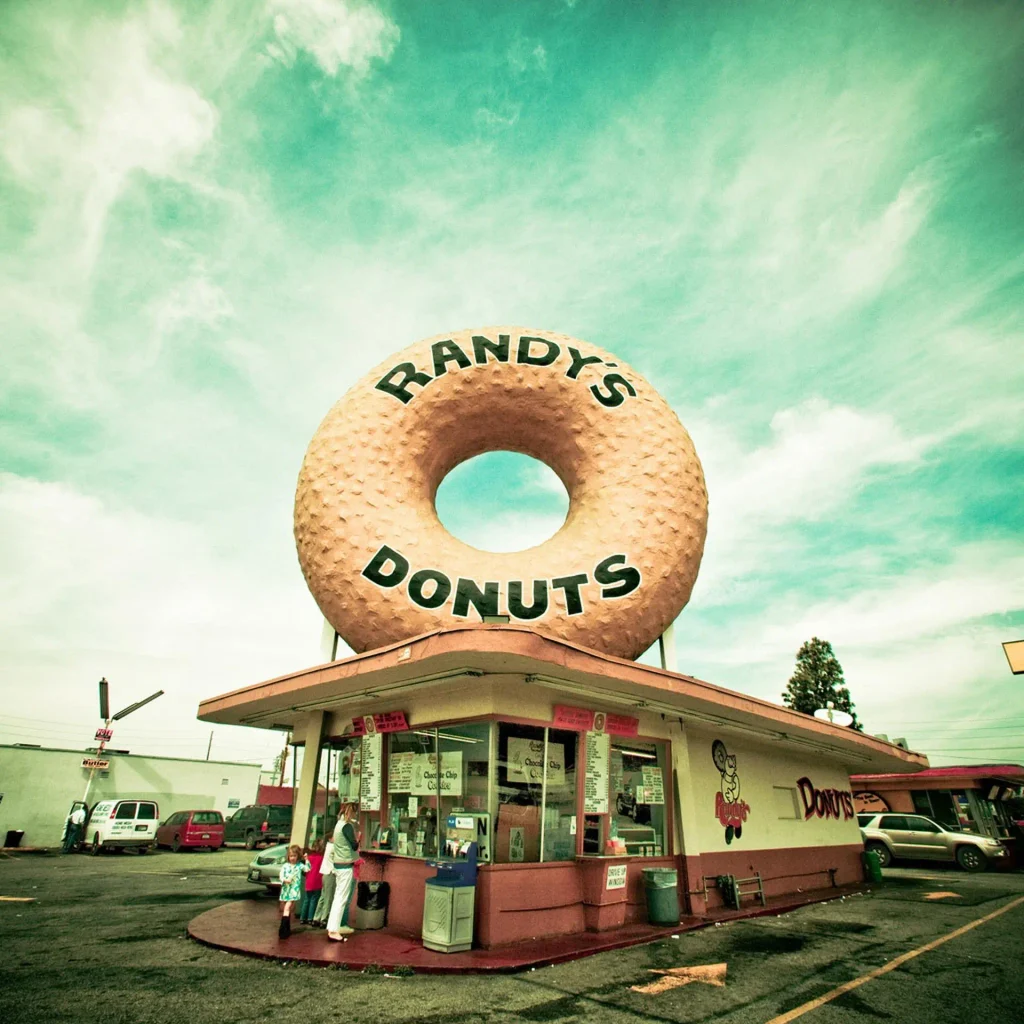
Randy’s Donuts is an iconic brand recognized worldwide. Featured in films and television for decades, the giant Randy’s Donuts sign in Los Angeles has become a symbol of American food culture. Learn more about the company’s story.
1. Iconic Branding and Global Recognition
Few brands in the food industry enjoy the same level of recognition as Randy’s Donuts. The shop opened in 1952 in Inglewood, California, and its rooftop donut became a landmark. Franchisees instantly benefit from decades of brand awareness.
Randy’s Donuts ranked #152 in Entrepreneur Magazine’s 2025 Top 500 Franchises. In 2024, it placed #36 in the Top 200 Global and #3 for New & Emerging Brands.
2. Proven Operational Playbook
Randy’s provides a franchise support system that covers recipes, staff training, daily operations, and vendor sourcing. This takes the guesswork out of running a business.
New owners get onboarding and initial systems training. A confidential operations manual guides daily work, and the franchise team travels to each store to help launch it. See details on the Franchise Support page.
3. Scalable Hub-and-Spoke Model
The franchise system uses a hub-and-spoke model, where one central kitchen (Hub) supports multiple smaller outlets (Spokes). Spokes can include kiosks, in-line shops, drive-thru windows, and walk-up locations.
This allows franchisees to expand revenue streams efficiently without duplicating overhead. Randy’s seeks five-store development models, with exceptions in some cases.
4. Strong Financial Performance
Randy’s reports $1,026,789 average gross sales across 19 affiliate-owned and franchised shops (10 affiliate-owned and 9 franchised) during the 2025 Measured Period. This outperforms many other donut shop franchises, making it a compelling option for entrepreneurs.
During the 2025 Measured Period, the 19 shops posted a median of about $1,030,000 and ranged from about $580,000 to $1,743,000. The 9 franchised shops averaged about $825,778, while the 10 affiliate-owned shops averaged about $1,207,700. Gross sales are not profit.
A single Randy’s Donuts location has a total estimated initial investment of $252,500 to $717,500 including real estate costs. The initial franchise fee is $35,000 for the first Shop and $25,000 for each additional Shop. Total costs largely depend on your willingness to develop the Shop with baking capacity for your own or additional Shops.
A full five-store hub-and-spoke development is estimated at about $2.5 million. Ongoing fees are a 5% royalty and a 1.5% Brand Fund contribution on weekly gross sales.
Additional details can be found in the brand’s Franchise Disclosure Document (FDD).
5. National and International Appeal
Randy’s Donuts has expanded across the United States and internationally, which proves the global scalability of its brand.
5 Top Benefits of Randy’s Donuts Franchise
- Instant brand recognition with decades of pop-culture exposure.
- Proven sales performance, with $1,026,789 average gross sales across 19 affiliate-owned and franchised shops (10 affiliate-owned and 9 franchised) during the 2025 Measured Period.
- Hub-and-spoke model for scalable, multi-unit growth.
- Comprehensive training and support for new owners.
- Global expansion potential across U.S. and international markets.
Success Stories from Randy’s Donuts Franchisees
Many franchisees have found success by joining the Randy’s system:
- Customers often line up on opening day thanks to brand recognition alone.
- The operational guidance allows new owners, even those without foodservice backgrounds, to run efficiently from day one.
- International partners have brought Randy’s to new countries, showcasing its worldwide appeal and adaptability.
- Grand opening support brings the franchise team on-site to help launch each store.
These success stories show that Randy’s is a cultural phenomenon with real business results.
Comparing Donut Shop Franchises: Randy’s vs. Independent Shops
| Factor | Independent Donut Shop | Randy’s Donuts Franchise |
| Branding | Build from scratch | Decades of global recognition |
| Training | Owner-developed | Comprehensive franchise training |
| Marketing | Self-funded, local | National & international campaigns |
| Expansion | Single shop at a time | Hub-and-spoke model for growth |
| Sales Potential | Varies widely by location and format | $1,026,789 average gross sales across 19 shops (2025 Measured Period) |
Frequently Asked Questions
What is a donut shop franchise?
A donut shop franchise is a licensed business model. An entrepreneur uses an established brand’s systems, recipes, trademarks, and operating standards to open and run a store.
Why choose Randy’s Donuts over other franchise donut shops?
Randy’s Donuts offers iconic branding and a scalable hub-and-spoke model, backed by strong financial performance, which makes it stand out among donut shop franchises. In addition, coffee is a complementary revenue stream; customers may stop in for donuts in the morning, but the “afternoon pick-me-up” of a cup of coffee brings them in all day long. Finally, fundraising and catering round out the possibilities.
Do I need foodservice experience to open a Randy’s Donuts franchise?
No. Many successful franchisees come from outside the restaurant industry. Randy’s provides training and ongoing support to help anyone run the business effectively.
How much does it cost to open a Randy’s Donuts franchise?
A single location has a total estimated initial investment of $252,500 to 563,500, including real estate costs. That’s for an in-line location. Adding baking capacity for your own shop alone will add costs. The initial franchise fee is $35,000 for the first Shop and $25,000 for each additional Shop.
A full five-store hub-and-spoke, multi-year development is estimated at about $2.5 million. See the Franchise Opportunity page for full details.
What are the ongoing fees for a Randy’s Donuts franchise?
Franchisees pay a 5% royalty and a 1.5% Brand Fund contribution on weekly gross sales, plus a local marketing requirement. Combined Brand Fund, local marketing, and cooperative spend is capped at 5% of gross sales.
How many locations do I need to open?
Development agreements generally begin with five locations under the hub-and-spoke model, with a $12,500 per-Shop deposit as part of the development fee. This model suits experienced, multi-unit investors.
Is owning a donut shop profitable?
During the 2025 Measured Period, the 9 franchised Randy’s Donuts shops averaged about $825,778 in gross sales. All 19 affiliate-owned and franchised shops averaged $1,026,789. Remember: gross sales are not profit, and actual results depend on location and cost control.
The Bottom Line
The donut shop franchise industry is thriving, and Randy’s Donuts gives new owners a proven way to enter it. The brand brings clear advantages to first-time franchise owners:
- Iconic branding and global recognition.
- Average gross sales of $1,026,789 across 19 affiliate-owned and franchised shops (10 affiliate-owned and 9 franchised) during the 2025 Measured Period.
- Comprehensive franchise support and training.
- Scalable hub-and-spoke model for multi-unit growth.
Ready to roll into the donut business? Contact us to start the conversation with the Randy’s Donuts franchise team.